Fraxinus pennsylvanica Urbanite®
Common name:
Urbanite Green Ash
Pronunciation:
FRAKS-i-nus pen-sil-VAN-i-ka
Family:
Oleaceae
Genus:
Synonyms:
Fraxinus americana Urbanite®
Fraxinus biltmoreana Urbanite®
Type:
Broadleaf
Native to (or naturalized in) Oregon:
No
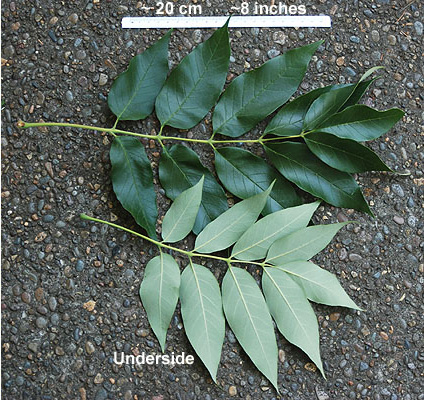
- Broadleaf deciduous tree, dense, broadly pyramidal, to about 50 × 40 ft (15 × 12 m). thick bark. Leaves large, thick, usually 9 leaflets, occasionally 11, margin entire, glossy green, light green to silvery below, bronzy in fall. Seedless.
- Sun
- Hardy to USDA Zone 5 Selected by Willet Wandell from seeds collected in 1965 from a tree in Danville, Illinois (PP 6,215; 1988).
- Alert: An invasive, non-native, insect pest, the Emerald Ash Borer (EAB) is present in Oregon and in much of the easthern U.S. The larvee of this pest feed on the inner bark of ash trees native to North America and Eurpoe, disrupting nutrient and water transport, which often results in tree death. For more information on this potentionally devistataing insect pest, click on Fraxinus in the Genus listing above.
- What species?: "This plant was initially identified as F. pennsylvanica [green/red ash], but Dirr (1997) [should be Dirr (2009), p.451], Jacobson (2003) [Plant of the Month: November 2003. Urbanite® Ash] and others have pointed out the error. Some recent collections of this cultivar have confirmed its hexaploid status (J. Campbell 2016.09-6, 7, 10, 12, 94 & 95 at NY)" ( Campbell, J.J.N. 2017 Phytoneuron 28: 1–36). This suggests that Urbanite® is not a green/red ash but rather is a white ash and should recognized as Fraxinus americana Urbanite® or, as according to Campbell, as Fraxinus biltmoreana Urbanite®. It is likely that the nursery industry will be slow to incorporate such a change.
- Oregon State Univ. campus: several in the parking lot southwest of Reser Stadium.
Click image to enlarge
-

plant habit
-

foliage and leaves
-

leaves
-

leaflet
-

foliage, fall
-

leaf, fall