Lagerstroemia 'Acoma'
Common name:
Acoma Crape Myrtle
Pronunciation:
la-ger-STRO-me-a
Family:
Lythraceae
Genus:
Type:
Broadleaf
Native to (or naturalized in) Oregon:
No
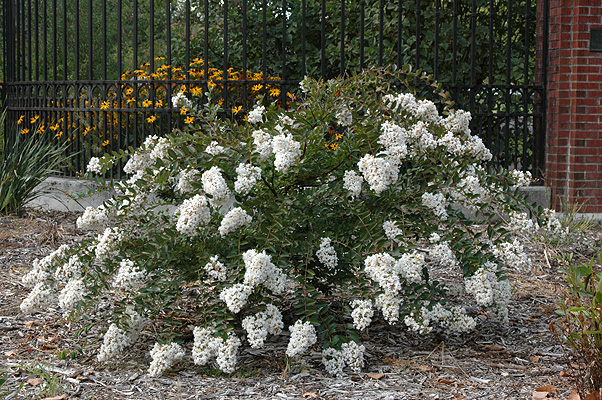
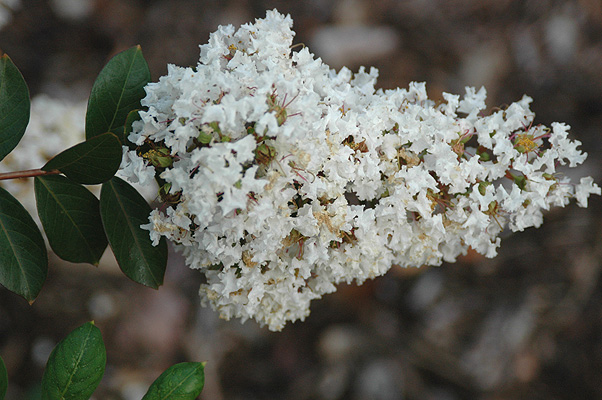
- Broadleaf deciduous shrub, low spreading, semi-dwarf, multi-stemmed, semi-pendulous, to about 10 ft (3 m) tall with a somewhat greater width, branches are reddish, becoming light gray, older branches and trunk develop exfoliating bark. Leaves elliptic to obovate, dark bronze-tinted when young, becoming dark semi-glossy green, and turning dark purple-red in fall. Flowers are pure white with golden anthers, in long, pendulous clusters about 15-19 cm in length.
- Full sun, moist well-drained soil; mildew-resistant.
- Hardy to USDA Zone 6 A cross of [L. indica ‘Pink Ruffles’ × L. indica] × L. fauriei seedling.
- see HortScience 21(5):1250-1252(1986): Here is the Abstract: ‘Acoma’, ‘Hopi’, ‘Pecos’, and ‘Zuni’ are the first semi-dwarf Lagerstroemia indica x L. fauriei Koehne cultivars that combine mildew resistance and a range of flower colors. Crape-myrtle, the common name of Lagerstroemia, is the most widely cultivated summer-flowering large shrub or small tree in the southern United States. The 4 prior U.S. National Arboretum L. indica x L. fauriei introductions— ‘Muskogee’, ‘Natchez’, ‘Tuscarora’, and ‘Tuskegee’—are small trees 7-10 m high (4—6), whereas those described herein are 4 semi-dwarf cultivars. ‘Acoma’, ‘Hopi’, ‘Pecos’, and ‘Zuni’ raise the total U.S. National Arboretum Lagerstroemia cultivar releases to 14 (2, 3)
- Oregon State Univ. campus: at the 11th Street Gate (Campus Way and 11th St).
Click image to enlarge
-
plant habit, flowering
-
plant habit, flowering (10 years later)
-
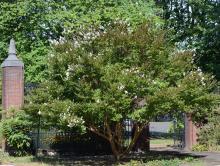
plant habit, late summer (16 years later)
-
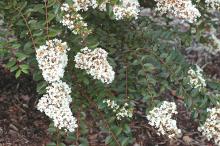
flowering shoot
-
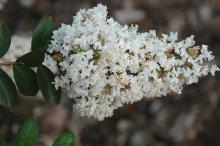
flower cluster
-

plant habit, fall
-
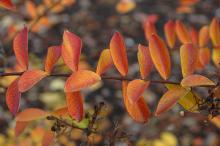
leaves, fall