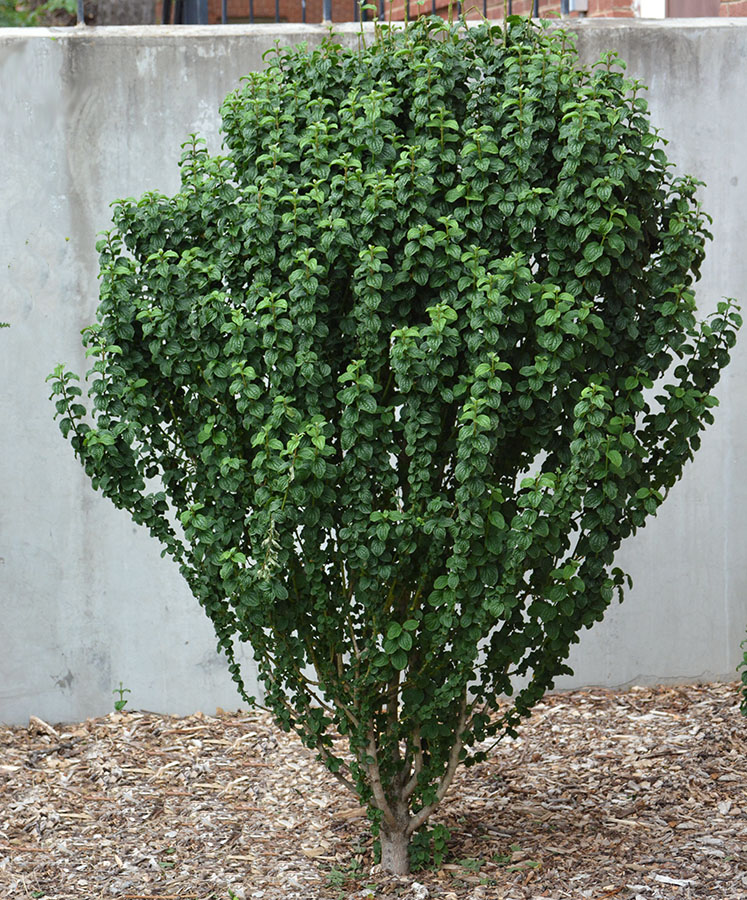
Cornus sericea subsp. sericea 'Hessei'
Common name:
Siberian Dogwood
Hessei Dogwood
Pronunciation:
KOR-nus ser-EE-se-a subsp. ser-EE-se-a
Family:
Cornaceae
Genus:
Synonyms:
Cornus sericea 'Hessei"
Cornus alba 'Hessei'
Type:
Broadleaf
Native to (or naturalized in) Oregon:
No
- A deciduous, dwarf shrub with dense, upright branches and a spreading habit. It may reach a height of 10 ft (3 m) in 6-10 years. Leaves are small, obtuse shaped, crinkled, crowded and green; but turn purple in fall. Flowers are creamy-white and borne in dense clusters up to 4 cm across. Ripening white fruit contrasts sharply with the purple leaves.
- Sun to part shade. Some recommend pruning old stems to the ground to encourage new stems with better yellow color. Apparently the flowers are sterile and, therefore, does not set seed.
- Hardy to USDA Zone 2 Raised by Herman Albrecht Hesse (1852 - 1937) - German nurseryman (Hesse Nurseries), originator of several woody plants including conifers. A number of cultivars carry the nursery's name.
-
Note: Some nurseries still use the name Cornus alba, although it, and its associated cultivars, are now classified as a subspecies of Cornus sericea, hence Cornus sericea supsp. sericea. However, the name of selections and cultivars in the nursery trade are often given without the subspecies designation. Example: Cornus sericea ‘Flaviramia’.
Click image to enlarge
-

plant habit, winter
-

plant habit
-

foliage
-

leafy shoot tip